What do you all think about using the d-dimer test in the decision to stop or continue anticoagulation in patients with a first idiopathic thrombotic event?
Here is the abstract from Current Opinion in Pulmonary Medicine. 13(5):393-397, September 2007.
Abstract
Purpose of review: The optimal duration of oral anticoagulation after a first idiopathic venous thromboembolism is uncertain. Recent prospective observational studies show that D-dimer levels have a predictive value for the risk of recurrence. D-dimer testing may help in assessing the individual need for prolonged anticoagulation.
Recent findings: The recently published Prolong study investigated 608 patients with a first unprovoked venous thromboembolism who had received oral anticoagulation for at least 3 months. D-dimer testing was performed 1 month after anticoagulation withdrawal. Patients with normal D-dimer (n = 385) did not resume anticoagulation. Patients with abnormal D-dimer were randomized to resume (n = 103) or not resume (n = 120) anticoagulation. All patients were followed for an average of 1.4 years. Study outcomes occurred in 6.2% of patients with normal D-dimer, and in 15.0% and 2.9% of those with abnormal D-dimer who were allocated to stop or to resume anticoagulation, respectively.
Summary: Patients with an abnormal D-dimer measured 1 month from anticoagulation withdrawal have a significant incidence of recurrent venous thromboembolism which is reduced by resumption of anticoagulation. The risk of recurrence in patients with normal D-dimer is significantly lower. D-dimer testing can be used to regulate the duration of anticoagulation.
Showing posts with label Thromboembolic disease. Show all posts
Showing posts with label Thromboembolic disease. Show all posts
Sunday, September 09, 2007


Wednesday, April 11, 2007
Dose of T-PA - Part Deux
I didn't get much feedback or interest on the post below on T-PA and empyemas so I contacted our T-PA rep and we got some references on the matter.
The dose varies widely and it seems you just can't go wrong...
In the Chest abstract I had listed in the original post the authors used 10 mg per instillation.
In a brief review/case report in Hospital Pharmacy in 2003 (vol 38 (11); pp: 1024-29) the authors used 16mg/100ml NSS infused daily. They derived the dose by extrapolating the ratio of Streptokinase usually used in empyemas to the dose for MI's.
In another Chest abstract, the initial dose was 10mg for complicated hemothoraces and that was increased to 25mg, still with good tolerability.
The pediatric literature was a bit more consistent and usually 0.1mg/kg was used in various trials.
Any other suggestions?
The dose varies widely and it seems you just can't go wrong...
In the Chest abstract I had listed in the original post the authors used 10 mg per instillation.
In a brief review/case report in Hospital Pharmacy in 2003 (vol 38 (11); pp: 1024-29) the authors used 16mg/100ml NSS infused daily. They derived the dose by extrapolating the ratio of Streptokinase usually used in empyemas to the dose for MI's.
In another Chest abstract, the initial dose was 10mg for complicated hemothoraces and that was increased to 25mg, still with good tolerability.
The pediatric literature was a bit more consistent and usually 0.1mg/kg was used in various trials.
Any other suggestions?
Monday, April 09, 2007
Dose of T-PA
There is a wealth of articles on using fibrinolytics in empyema (with mixed results) listing the doses for urokinase and streptokinase. I have had trouble finding a narrower consensus on T-PA dosing though. The Pediatric literature suggests ~4mg/kg and there is a dose of 2mg for clotted central venous access. I also found an abstract from Chest where doses of 10 mg were used but couldn't find a good consensus.
Have you used T-PA in empyemas? And how much?
Have you used T-PA in empyemas? And how much?
Thursday, May 18, 2006
Fondaparinux
Fondaparinux was better than Enoxaparin for DVT prevention after knee surgery in a NEJM study. For medical patients, though, have you been using much fondaparinux for DVT prophylaxis or is a LMWH still your default?
Monday, May 01, 2006
Abnormal CT scan
72 year opld with severe COPD developed right sided pleuritic chest pain. No fever chills or increased shortness of breath.
A chest xray at baseline is shown here:
A chest xray at baseline is shown here:
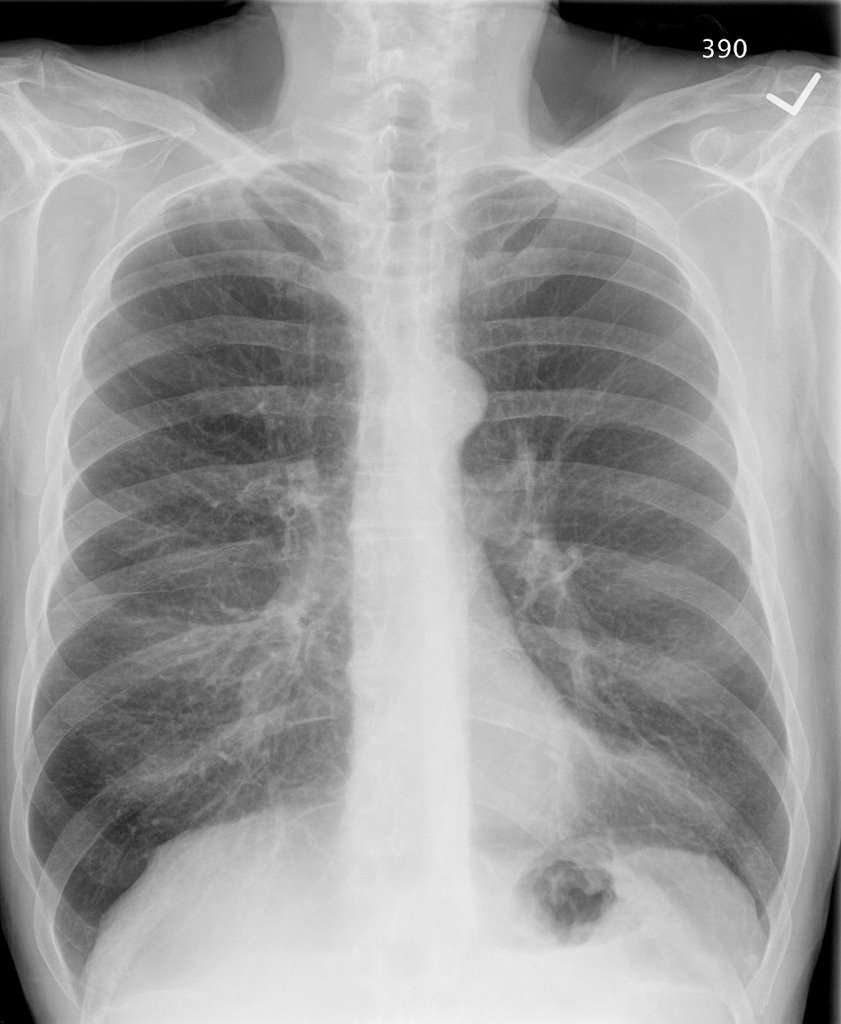
A chest xray with the pain is shown here:

Based on that CXR, he was diagnosed with RUL pneumonia and prescribed a Z-Pak. His pain pertsisted. A month later a f/u chest CT was done. Other than severe upper lobe emphysema, the pertinent slice is shown here:
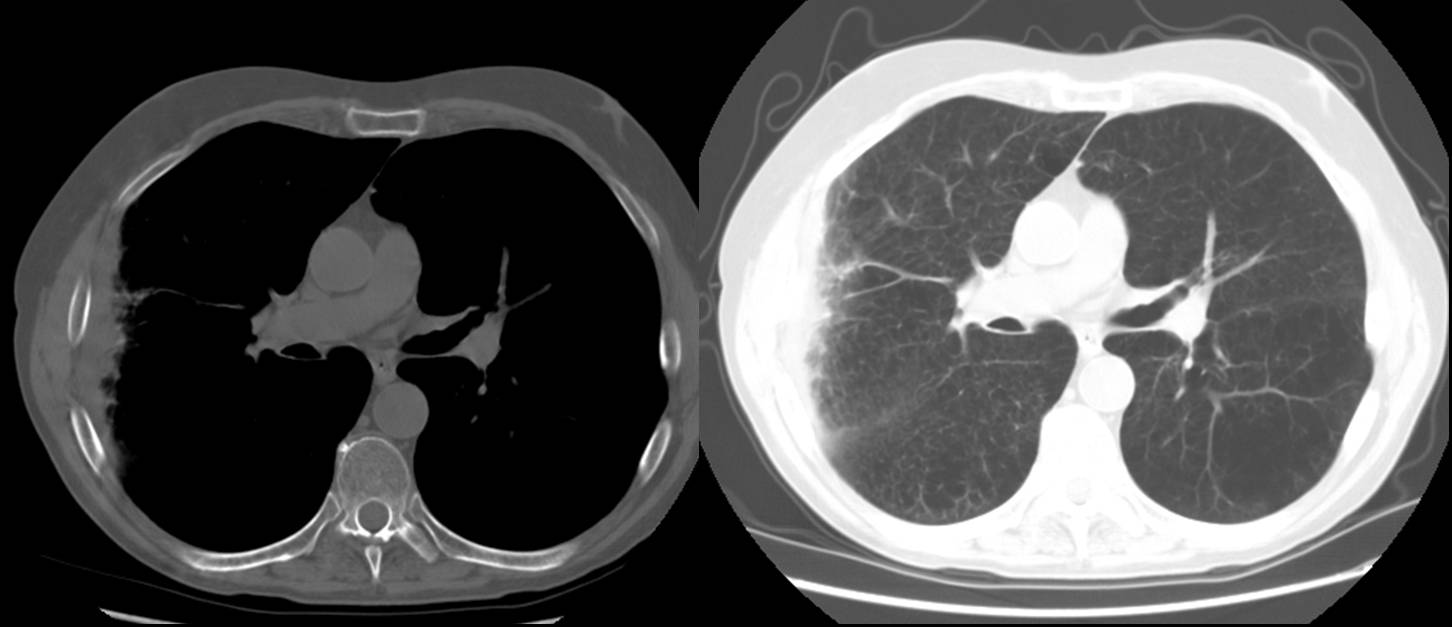
Any comments?
Tuesday, April 18, 2006
DVT/PE
This was brought up this week:
"Does anyone know the reference for a study that showed in patients who were asymptomatic from a cardiopulmonary perspective but had a positive LE doppler for a DVT the incidence of documented PE on a PA-gram?
I know there is a study showing this, but I cannot find the reference."
"Does anyone know the reference for a study that showed in patients who were asymptomatic from a cardiopulmonary perspective but had a positive LE doppler for a DVT the incidence of documented PE on a PA-gram?
I know there is a study showing this, but I cannot find the reference."
Friday, March 31, 2006
?PE
A 71 yo male with CRI and a creatinine of 4 presented with dehydration and a wide A-a gradient. CXR was normal. His creatinine bumped on admission; as such, we did not want to do a CT scan. So, we obtained a V/Q scan.
Quick question: if a patient has an indeterminent V/Q scan because of a mismatched defect in the RML medial segment, can a PE be effectively ruled out with an isolated injection of the corresponding vessel supplying the RML?
Quick question: if a patient has an indeterminent V/Q scan because of a mismatched defect in the RML medial segment, can a PE be effectively ruled out with an isolated injection of the corresponding vessel supplying the RML?
Subscribe to:
Posts (Atom)