Here is an interesting question submitted by "zolt"
OK we all know that oxygen accelerates the rate of absorption of pneumothorax by about 4 times and so is of value in patients with pneumothorax being managed conservatively. Now in patients with hydropneumothorax with collapse with BPF with tube thoracostomy, is there any role of intermittent oxygen? how will be the diffusion mechanics in such patients or will all the oxygen come out through BPF?
Showing posts with label physiology. Show all posts
Showing posts with label physiology. Show all posts
Monday, September 10, 2007


Thursday, July 26, 2007
Steroid responsive adenopathy?
65-year-old woman presented initially for evaluation of shortness of breath. A CT thorax revealed some patchy airspace opacification RUL (see below) . She underwent bronchoscopic evaluation and it demonstrated some interstitial inflammation with hyperplastic type 2 pneumoctyes. No granulomas seen. No fungal or AFB elements on BAL. A cell count was not sent.
She was begun on a course of steroids 40mg and felt her breathing improved significantly while on them, but once she stopped them, her shortness of breath recurred. Her cough has also recurred, though it's mostly non-productive. A CT was repeated 5 monts later and is shown below.

Question: What ILD had adenopathy and is steroid responsive? The only 2 I can think of are sarcoid and berrylliosis, but the interstial inflammation would be inconsistent with that. Any thoughts out there?
She was begun on a course of steroids 40mg and felt her breathing improved significantly while on them, but once she stopped them, her shortness of breath recurred. Her cough has also recurred, though it's mostly non-productive. A CT was repeated 5 monts later and is shown below.

Question: What ILD had adenopathy and is steroid responsive? The only 2 I can think of are sarcoid and berrylliosis, but the interstial inflammation would be inconsistent with that. Any thoughts out there?
Friday, April 20, 2007
low DLCO in runner
Submission from Hal :
15 y/o WF distance runner on track team c/o SOB. No improvement in the past year as perceived inability to breathe. She is is 5 7 tall, 115 pounds. All State, All American runner in 1600M and 800M.
PFTs showed DLCO 71% pred (18.9 with ref 26.6), DL Adj 80% (18.9 with 23.5 ref).
VA 5.09 L
FVC 106%, FEV1 100%, FEF25-75 96%.
Chest xray showed...ordered but not done yet.
Normal CBC
Any thoughts on etiology and suggestions for further work-up?
15 y/o WF distance runner on track team c/o SOB. No improvement in the past year as perceived inability to breathe. She is is 5 7 tall, 115 pounds. All State, All American runner in 1600M and 800M.
PFTs showed DLCO 71% pred (18.9 with ref 26.6), DL Adj 80% (18.9 with 23.5 ref).
VA 5.09 L
FVC 106%, FEV1 100%, FEF25-75 96%.
Chest xray showed...ordered but not done yet.
Normal CBC
Any thoughts on etiology and suggestions for further work-up?
Tuesday, February 13, 2007
Low DLCO
Here is a submission from John B: It is interesting that it is close to the very first post of this blog.
I continually test a low (60% I think) DLCO on a PFT. All other parts of that test are normal.
I have dizziness, lightheadedness, sob (random- at rest or exertion). Palpitations at times, but not nearly as often as in the past.
Occasional feeling of pressure in chest. Echo was normal, but imo it looks like values have been increasing over the past 2 years- still in normal ranges, but I do show some trace/mild tricuspid regurg and trace mitral regurg.
Two times I have done a cardiopulmonary stress test, and both times it shows a cardiovascular limitation evidenced by crossing of the anaerobic threshold earlier than I should- metabolic acidosis after exertion.
Nuclear stress test shows no blockages.
Also, my own testing with a pulse oximeter seems to indicate occasional drops in my O2 to as low as 92, but then quickly recovering to 96-98. This has never happened in doctor's office with their oximeters, so I don't know if mine is accurate (however, when testing my wife as a control subject, she always shows 96-98).
high-res CT scan of chest - normal (6 months ago)
non-invasive ct angiography (body scan) - normal lungs / lung blood vessels (1+ year ago)
- calcium score was 0 (2 years ago)
multiple echocardiograms are in normal range but show trace / mild regurgitation
- cardiopulmonary stress test shows a cardiovascular limitation evidenced by a metabolic acidosis at peak exercise
- low DLCO (+-60% of predicted - 1 month ago)
- nuclear stress test shows no blockages (1.5 years ago)
- triglycerides 270 - vldl 56 - ldl 240 - hdl 36)
- lyme disease- treated with abx in past
No one knows what to make of this. I was thinking of requesting a stress echo, to see if there is more regurgitation after exercise.
Any other tests I should have done? Would really appreciate some assistance. I can provide more specific data if needed.
-John
I continually test a low (60% I think) DLCO on a PFT. All other parts of that test are normal.
I have dizziness, lightheadedness, sob (random- at rest or exertion). Palpitations at times, but not nearly as often as in the past.
Occasional feeling of pressure in chest. Echo was normal, but imo it looks like values have been increasing over the past 2 years- still in normal ranges, but I do show some trace/mild tricuspid regurg and trace mitral regurg.
Two times I have done a cardiopulmonary stress test, and both times it shows a cardiovascular limitation evidenced by crossing of the anaerobic threshold earlier than I should- metabolic acidosis after exertion.
Nuclear stress test shows no blockages.
Also, my own testing with a pulse oximeter seems to indicate occasional drops in my O2 to as low as 92, but then quickly recovering to 96-98. This has never happened in doctor's office with their oximeters, so I don't know if mine is accurate (however, when testing my wife as a control subject, she always shows 96-98).
high-res CT scan of chest - normal (6 months ago)
non-invasive ct angiography (body scan) - normal lungs / lung blood vessels (1+ year ago)
- calcium score was 0 (2 years ago)
multiple echocardiograms are in normal range but show trace / mild regurgitation
- cardiopulmonary stress test shows a cardiovascular limitation evidenced by a metabolic acidosis at peak exercise
- low DLCO (+-60% of predicted - 1 month ago)
- nuclear stress test shows no blockages (1.5 years ago)
- triglycerides 270 - vldl 56 - ldl 240 - hdl 36)
- lyme disease- treated with abx in past
No one knows what to make of this. I was thinking of requesting a stress echo, to see if there is more regurgitation after exercise.
Any other tests I should have done? Would really appreciate some assistance. I can provide more specific data if needed.
-John
Thursday, November 30, 2006
Airway remodelling
I have posted a question on this a while ago. I see a fair number (just saw one today) of older patients (usually women) who have never smoked, have normal gas exchange and chest radiography but who present with moderately severe degrees of fixed obstructive lung disease. They never have any history of asthma, cough or wheezing and their only complaint is DOE.
Usually there is some small-airway obstruction on the expiratory images of a HRCT but no other structural abnormalities.
Have you seen much of that? How do you label these patients? Unsuspected asthma with remodelling?
Usually there is some small-airway obstruction on the expiratory images of a HRCT but no other structural abnormalities.
Have you seen much of that? How do you label these patients? Unsuspected asthma with remodelling?
Tuesday, September 26, 2006
Hemodynamics
A patient intubated and sedated for hypoxia (history of aspiration although CXR negative) had initial swan numbers of: CO 5 L, CI 3.24 PAP 26/16. PCW 8 with cvp of 4. SVR 1362. PVR is 190. AFter fluid boluses with no change in CO, PCW still 8 with a CVP of 6. His SBP has been 116/78 basically unchanged throughout. After fluid blouses he is now about 10 L up with really no change in the above swan readings or bloodpressure. How would you interpret this? Of note a surface echo showed an EF of 25-35%.
Here's his cxr.
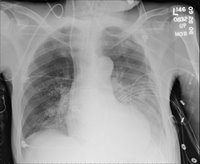
Here's his cxr.

Thursday, August 24, 2006
Prune-belly
I have just seen a 26 y/o patient in the office for recurrent respiratory tract infections. He has a Hx of prune-belly syndrome (poor abdominal muscle development with severe urinary tract abnormalities) and has been on HD after a failed renal Txp.
These patients tend to have a restrictive physiology because of the oligohydramnios and sometimes even have hypoplastic lung. Indeed his TLC is ~66%. His Cxr is pretty unremarkable but he also has an associated obstructive defect: FEV1 is ~36% witha ratio of<70%. Has anybody seen this condition (or similar ones) be associated with asthma/reactive airways disease?
These patients tend to have a restrictive physiology because of the oligohydramnios and sometimes even have hypoplastic lung. Indeed his TLC is ~66%. His Cxr is pretty unremarkable but he also has an associated obstructive defect: FEV1 is ~36% witha ratio of<70%. Has anybody seen this condition (or similar ones) be associated with asthma/reactive airways disease?
Tuesday, August 22, 2006
CPET
What do you think of this CPET data?
61 y/o obese woman (BMI: 37.3), S/P remote CABG with patent grafts and normal LVEF on recent angiography with persistent DOE. Very remote smoking Hx with only a mild restrictive defect (FVC~70% with FEV1/FVC>80), normal DLCO and normal HRCT. Negative methacholine challenge.
DATA (predicted values and/or percentages):
VO2max (ml/kg/min): 14.4 (25.4/56%)
AT: 0.749 (>0.698) - 43% predicted VO2max (>40%)
Max HR 73% predicted with still good reserve: 44. O2 pulse 11.5 (8.4)
VE max: 50.7 (65.9 / 77%)
Vt: 1.28 (0.563)
Respiratory rate: 36 (<50)
Breathing reserve: 2% (20-40%)
Vd/Vt at rest: 0.51 (0.30)
Vd/Vt at peak: 0.26 (0.18)
RQ: 0.93 (1.1-1.3)
No desat.
FVC at peak declined by 19% and FEV1 at peak did not change.
61 y/o obese woman (BMI: 37.3), S/P remote CABG with patent grafts and normal LVEF on recent angiography with persistent DOE. Very remote smoking Hx with only a mild restrictive defect (FVC~70% with FEV1/FVC>80), normal DLCO and normal HRCT. Negative methacholine challenge.
DATA (predicted values and/or percentages):
VO2max (ml/kg/min): 14.4 (25.4/56%)
AT: 0.749 (>0.698) - 43% predicted VO2max (>40%)
Max HR 73% predicted with still good reserve: 44. O2 pulse 11.5 (8.4)
VE max: 50.7 (65.9 / 77%)
Vt: 1.28 (0.563)
Respiratory rate: 36 (<50)
Breathing reserve: 2% (20-40%)
Vd/Vt at rest: 0.51 (0.30)
Vd/Vt at peak: 0.26 (0.18)
RQ: 0.93 (1.1-1.3)
No desat.
FVC at peak declined by 19% and FEV1 at peak did not change.
Wednesday, August 09, 2006
Acid Base
The chem-7 and the gas were both drawn within 22 minutes of each other in this 71 year old intubated man with sepsis and ARDS:
7.08/24/226 on fio2 of 75%
Na 145
k 5.2
Cl- 114
HCO3 28
BUN 42
Cr 0.5
What is the acid base disturbance?
7.08/24/226 on fio2 of 75%
Na 145
k 5.2
Cl- 114
HCO3 28
BUN 42
Cr 0.5
What is the acid base disturbance?
Thursday, June 29, 2006
Pneumothorax and pilot's license
This was left as a comment for this case on pneumothorax, but I reposted it here, as it is interesting:
I am a 19-yr old who had a right spontaneous pneumothorax. BP: 130/70-ish Oxygen Sat: 98% HR: 62
Chest tube inserted first, and then VATS done. First chest xray showed my right lung had collapsed to a size of about 10 to 20% of the original size. Subsequent X-rays after the VATS showed that my lung had re-expanded to 90% of its original size. The surgeons warned of a 10% chance of recurrence or occurrence in the other lung.
My question is, I am passionate about flying, and already secured a place in the undergraduate program in Bachelor of Science (Aviation) in Perth's Edith Cowan University, which includes Commercial Pilot's License. They are waiting for my acceptance. Do I still have the medical conditions and requirements to fly?
I am a 19-yr old who had a right spontaneous pneumothorax. BP: 130/70-ish Oxygen Sat: 98% HR: 62
Chest tube inserted first, and then VATS done. First chest xray showed my right lung had collapsed to a size of about 10 to 20% of the original size. Subsequent X-rays after the VATS showed that my lung had re-expanded to 90% of its original size. The surgeons warned of a 10% chance of recurrence or occurrence in the other lung.
My question is, I am passionate about flying, and already secured a place in the undergraduate program in Bachelor of Science (Aviation) in Perth's Edith Cowan University, which includes Commercial Pilot's License. They are waiting for my acceptance. Do I still have the medical conditions and requirements to fly?
Tuesday, June 06, 2006
Phlebotomy and secondary polycythemia vera
Is there ever an indication for phlebotomies for secondary PCV? I was always under the impression that the treatment is supplemental oxygen. Is there any data to support this practice?
Wednesday, May 31, 2006
Follow up to myopathy and low DLCO
Our reader with a myopathy and +ANA has sent us the following follow up on her case (also in the comment section):
'Just an update. I saw the new pulmo. doc and was very impressed. My pft's yesterday revealed a restrictive process that he felt was compatible with the neuromuscular disease. My dlco remains low. He's not sure why as he said that it doesn't necessarily fit in with the myopathy. He also was concerned with the high ANA and repeated that yesterday along with some other labs. He reviewed the ct chest and he noticed the enlarged lt atrium on the ct.When I go back to see him,he is going to repeat some more specific neuromuscular pft's.I told him what my cardiologist has said about not treating until the ef was < 30%. He did not feel comfortable with that as he felt that was too low to wait for treatment.Thank you for this great site.
'Just an update. I saw the new pulmo. doc and was very impressed. My pft's yesterday revealed a restrictive process that he felt was compatible with the neuromuscular disease. My dlco remains low. He's not sure why as he said that it doesn't necessarily fit in with the myopathy. He also was concerned with the high ANA and repeated that yesterday along with some other labs. He reviewed the ct chest and he noticed the enlarged lt atrium on the ct.When I go back to see him,he is going to repeat some more specific neuromuscular pft's.I told him what my cardiologist has said about not treating until the ef was < 30%. He did not feel comfortable with that as he felt that was too low to wait for treatment.Thank you for this great site.
Monday, May 08, 2006
Obesity-hypoventilation
I have recently seen this 75 y/o woman with significant obesity for persistent hypoxemia. She has no TOB Hx and not a lot of structural lung Dz. Her PFTs were remarkable for a pettern consistent with obesity. I thought alveolar hypoventilation might account for much of her hypoxemia and obatined an ABG. Her mid-day ABG revealed normal pH, paCO2 of 57 and a low paO2. Because of the hypoventilation, obesity and history of loud snoring I thought she might also have OSA. However, her sleep study showed nocturnal hypoxemia but no OSA.
Have you seen many cases of OHV without OSA or structural lung disease?
Would you start her on BiPAP? If so would you try and get a titration study even though she does not meet OSA criteria? Otherwise how would you choose her settings?
Have you seen many cases of OHV without OSA or structural lung disease?
Would you start her on BiPAP? If so would you try and get a titration study even though she does not meet OSA criteria? Otherwise how would you choose her settings?
Thursday, May 04, 2006
Myopathy and decreased DLCO
An outside question, posed here for any comments. Doug/Jeff H: maybe Fernando can address?
I am a41 yr old female dx'd with a probable mitochondrial myopathy. My muscle bx showed increased lipid drops. An EMG showed a myopathic trend. Testing for MG was negative. My pft's revealed fev1 77% of predicted, fev1/fvc 74%. Diffusing capacity at 69% of predicted- last one was 68%--DL/CO/VA of 5.45. MVV was 31% of predicted and negative inspiratory force was -10.
HRCT showed minimal bilateral basilar scarring vs interstitial changes. Echo showed left atrial enlargement,decreased lt ventricular systolic function,trace mitral and aortic regurgitation, ef of 45% (was >55% in 1999).
DO you think the decreased diffusion should be followed upon or is it because of the neuromuscular disease process going on? My pulmo said I have mild asthma but the muscle weakness is a bigger problem. Any suggestions would be appreciated.
Chest xray showed...normal except for degeneartive changes in the thoracic spine
My other PmHx is SF hashimoto&'s on synthroid. My ANA-1:640 speckled pattern
aldolase 7.1(1.2-7.6) ck 56.
I am a41 yr old female dx'd with a probable mitochondrial myopathy. My muscle bx showed increased lipid drops. An EMG showed a myopathic trend. Testing for MG was negative. My pft's revealed fev1 77% of predicted, fev1/fvc 74%. Diffusing capacity at 69% of predicted- last one was 68%--DL/CO/VA of 5.45. MVV was 31% of predicted and negative inspiratory force was -10.
HRCT showed minimal bilateral basilar scarring vs interstitial changes. Echo showed left atrial enlargement,decreased lt ventricular systolic function,trace mitral and aortic regurgitation, ef of 45% (was >55% in 1999).
DO you think the decreased diffusion should be followed upon or is it because of the neuromuscular disease process going on? My pulmo said I have mild asthma but the muscle weakness is a bigger problem. Any suggestions would be appreciated.
Chest xray showed...normal except for degeneartive changes in the thoracic spine
My other PmHx is SF hashimoto&'s on synthroid. My ANA-1:640 speckled pattern
aldolase 7.1(1.2-7.6) ck 56.
Tuesday, May 02, 2006
Exercise-induced asthma
What's the best way to diagnose exercise-induced asthma in a patient where the history seems to fit and baseline spiro is negative: methacholine challenge or post-exercise spirometries?
Wednesday, April 26, 2006
Physiology question
I am hoping to stimulate some discussion involving a simple question with complex pulmonary physiology.
2 questions involving a patient with COPD who is a known CO2 retainer (pCO2 around 50-60 with a preserved pH) at baseline:
1. Why can putting them on high flow oxygen (i.e. when they present to a Emergency with increased dyspnea) worsen their CO2 retention?
2. How do you know how much oxygen to give these individuals if they are truly hypoxemic?
2 questions involving a patient with COPD who is a known CO2 retainer (pCO2 around 50-60 with a preserved pH) at baseline:
1. Why can putting them on high flow oxygen (i.e. when they present to a Emergency with increased dyspnea) worsen their CO2 retention?
2. How do you know how much oxygen to give these individuals if they are truly hypoxemic?
Tuesday, April 11, 2006
Pulmonary function
How would you define these pfts? The ratio is 72 (96% predicted). FEV1 63% pred and FVC 65%.
The TLC is 84% predicted and the DLCO is 44%.
The TLC is 84% predicted and the DLCO is 44%.
Monday, March 27, 2006
Quick question on the VEST
Have you had any good (or bad) anecdotal experience with the Vest for respiratory secretion clearing? There are some published trials and I have a few people with bronchiectasis, including the Pt with Kartagener's using it.
Monday, March 13, 2006
Polycythema vera
A man with mild COPD (FEV1 69%, DLCO 88%) who still smokes was found to have a hematocrit of 51. His hematologist has been subjecting him to phlebotomies. Here is the data:
1. The patient is not hypoxic. A 6 minute walk on RA also did not show hypoxia. A blood gas shows: PaO2 mmHg 94.5, PaCO2 mmHg 35.0.
2. The patient's red blood cell mass was normal.
3.His erythropoietin level was 19, which was normal (the hct was 43.5 that day).
4. His Hct was once 55, but usually lower. He gets frequent phlebotomies when it goes to about 50, but they have neveer seen if it would go any higher.
Umm, with the above, my take is that this is NEITHER primary or secondary polycythemia. The quesitonthough, is, can smoking cause secondary PV without hypoxia? (if that were the case he shouldn't be getting phlebotomies anyway)
1. The patient is not hypoxic. A 6 minute walk on RA also did not show hypoxia. A blood gas shows: PaO2 mmHg 94.5, PaCO2 mmHg 35.0.
2. The patient's red blood cell mass was normal.
3.His erythropoietin level was 19, which was normal (the hct was 43.5 that day).
4. His Hct was once 55, but usually lower. He gets frequent phlebotomies when it goes to about 50, but they have neveer seen if it would go any higher.
Umm, with the above, my take is that this is NEITHER primary or secondary polycythemia. The quesitonthough, is, can smoking cause secondary PV without hypoxia? (if that were the case he shouldn't be getting phlebotomies anyway)
Friday, February 24, 2006
Ground glass opacities??
43 yo male with minimal PMH presents with 1 year history of constitutional symptoms (lethargy, intermittent fevers, and RUQ pain. Was diagnosed with elevated transaminases, but a cause (to date) has not been determined.
3-4 weeks ago, became progressively more dyspneic. Initially noted with moderate amts of exertion, but now is at rest. Denies any cough, sputum. Has some pleuritic CP. Still having intermittent fevers, chills and sweats.
No TB risk factors.
PMH: Hypertension, hyperlipidemia
FH: nothing strange (i.e. only HTN, DM2, CAD, etc)
No new meds. He is on a statin, (LFT’s have been stable since placement on this drug 9 months ago), BBlocker, aleve
PE: Temp 38.4; 90% on RA at rest… desaturates to 85% with 4 minutes of walking
Lungs: Clear
Tatoos on both upper extremities (professionally done)
Basic labs normal except AST and ALT in 400’s. They have not appreciably changed in 6 months.
Hepatitis panels negative; Abd u/s shows some “fatter liver” with boarderline splenomegaly
PFT’s
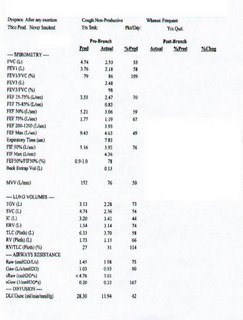
The CXR showed interstitial pattern; to save space, I will not include it. Most would have gotten a CT in f/u anyway.
CT (not high resolution)

What would you do next?
3-4 weeks ago, became progressively more dyspneic. Initially noted with moderate amts of exertion, but now is at rest. Denies any cough, sputum. Has some pleuritic CP. Still having intermittent fevers, chills and sweats.
No TB risk factors.
PMH: Hypertension, hyperlipidemia
FH: nothing strange (i.e. only HTN, DM2, CAD, etc)
No new meds. He is on a statin, (LFT’s have been stable since placement on this drug 9 months ago), BBlocker, aleve
PE: Temp 38.4; 90% on RA at rest… desaturates to 85% with 4 minutes of walking
Lungs: Clear
Tatoos on both upper extremities (professionally done)
Basic labs normal except AST and ALT in 400’s. They have not appreciably changed in 6 months.
Hepatitis panels negative; Abd u/s shows some “fatter liver” with boarderline splenomegaly
PFT’s
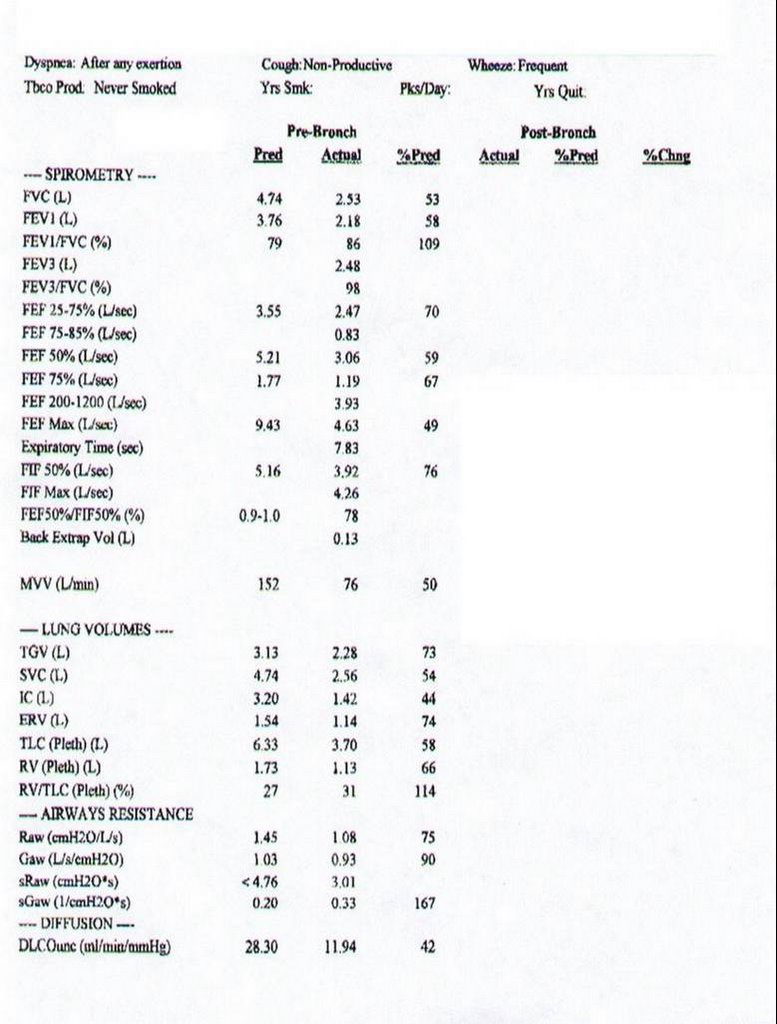
The CXR showed interstitial pattern; to save space, I will not include it. Most would have gotten a CT in f/u anyway.
CT (not high resolution)

What would you do next?
Subscribe to:
Posts (Atom)